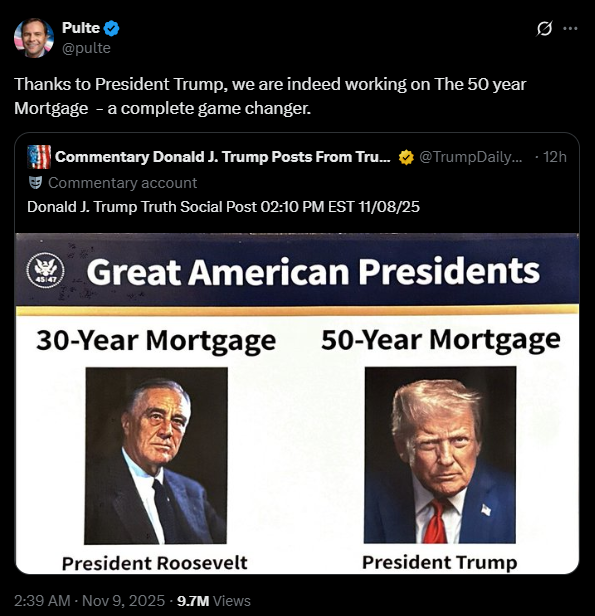
As mortgage rates have soared exponentially from pandemic lows of below 3% to 6.22%, the escalating challenge of housing affordability has become a central economic concern in the United States, driving policy discussions toward unconventional solutions. Amid reports from the National Association of Realtors (NAR) highlighting the median age of a first-time homebuyer climbing to 40, a proposal for a 50-year mortgage has emerged, championed by figures including President Trump and confirmed by FHFA Director Bill Pulte. While this structural attempt aims to provide immediate consumer relief by lowering monthly payments, it is likely to lead to homebuyers paying substantially more over the life of the loan, creating significant long-term financial consequences for both individual borrowers and the banking sector.
Reigniting the American Dream
The primary objective of extending the mortgage tenure is to directly decrease monthly housing payments. By stretching the repayment period from the traditional 30 years to five decades, the principal amount is distributed over a substantially longer term. The decrease in the monthly payment makes homeownership immediately more accessible to individuals facing budget constraints. This may potentially revitalise the "American dream" of owning a home for younger generations who are currently priced out of the market.
The implications for lenders and borrowers
While the shorter-term relief is clear, the long-term cost implications are substantial. For financial institutions, the 50-year mortgage represents a massive increase in the duration over which interest is collected. This extended timeline allows banks to accrue interest that could ultimately amount to many times the original value of the home, dramatically increasing the total profit generated from a single loan.
For the borrower, this structure means committing to five decades of debt service. The slow amortization process, where the initial payments are heavily weighted toward interest, translates into a significantly slower buildup of home equity compared to shorter-term loans. This increased interest payout and decades-long financial obligation represent the key trade-off for the initial reduction in monthly cash outflow.
A Hedge Against Monetary Erosion
The proposal is being discussed within the context of recent economic turbulence, notably the reported devaluation of the U.S. dollar and the accelerating erosion of its purchasing power, a trend visible in the substantial rise of asset values like gold since the start of the COVID-19 period. For some economic observers, a long-term, fixed-rate mortgage could be viewed as a strategic financial instrument.
In an environment of persistent inflation, the fixed debt owed on the mortgage remains constant, while the currency used to pay it back erodes in value. This dynamic presents the loan as a potential hedge, allowing the borrower to leverage long-term debt against monetary inflation. However, the success of this strategy is contingent upon the borrower's income growth keeping pace with or exceeding the rate of inflation over the next half-century.
The 50-year mortgage is therefore an economically complex proposition: an immediate injection of affordability into the housing market, counterbalanced by an unprecedented long-term commitment of wealth transfer from borrower to lender, all while navigating the unpredictable waters of future monetary policy and inflation.
Author

I hold a deep passion for tracking and analyzing the latest corporate performance and broader financial news. I enjoy understanding how these developments shape market trends and investment strategy.
Sign up for The Fineprint newsletters.
Stay up to date with curated collection of our top stories.