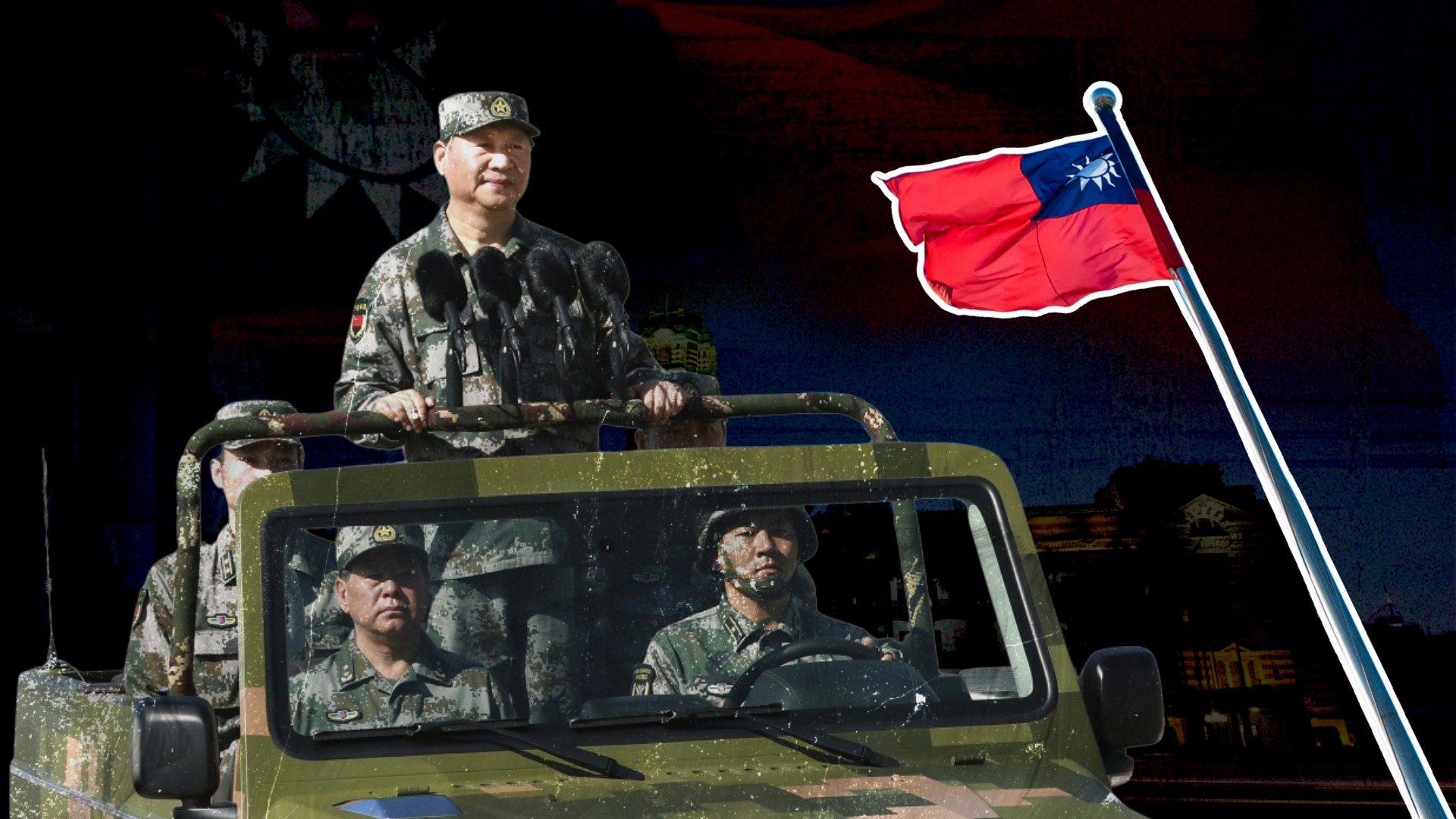
When Xi Jinping rose to power in 2012, he promised to rejuvenate China into a “world-class” military power and reinstate their global standing. More than a decade later, his grip is strongest not just on the Chinese Communist Party (CCP), but on the People’s Liberation Army (PLA)— a military unlike any other in the world. Unlike other modern militaries, which are accountable to their states, the PLA is answerable only to the CCP. Its leadership is chosen not for battlefield merit, but for loyalty to the communist party and for now Xi himself.
Over Xi’s three terms, this loyalty has been tested and reshuffled in unprecedented ways. Since 2023 alone, at least 14 generals — many of them his own appointees — have vanished or been investigated. The purge is the largest since the Mao Zedong era, and it underscores Xi’s paranoia: he is willing to remove even his handpicked loyalists to centralise power further.
But Xi’s consolidation is not just about political control. It’s also about Taiwan.
The Taiwan Question
Beijing has long pledged “peaceful unification” with Taiwan. But under Xi, military policy experts say China has set 2027 as the year the PLA must be ready to forcibly invade if necessary. Such a move would be catastrophic: amphibious invasions are notoriously difficult, and Taiwan has both U.S. backing and advanced military systems on its side.
In response to China’s rapid expansion of autonomous military technologies, the U.S. has awarded contracts to multiple defense firms to develop low-cost, rapidly deployable systems — including drones and surveillance balloons — signalling a shift toward a new era of warfare.
The more pressing issue is not just war itself, but what Taiwan represents: semiconductors. Taiwan produces over 60% of the world’s chips, and over 90% of the most advanced ones — including those used for artificial intelligence, 5G, and high-performance computing. A conflict across the Taiwan Strait would disrupt global supply chains, crippling industries from consumer tech to fighter jets.
For Singapore, which thrives as a logistics and financial hub, this is an existential concern. Our economy runs on stability and open trade. Any escalation could choke shipping routes through the South China Sea, disrupt semiconductor supply chains, and force Singapore to make difficult choices.
Xi’s Authoritarian Gamble
By tying the PLA so tightly to his personal authority, Xi is reshaping China’s military into an instrument of party power rather than national defence. The danger? A military that might follow orders unquestioningly — even into disaster.
Xi is expected to extend his rule into a fourth term, making him China’s longest-serving leader since Mao. His approach to governance is clear: absolute centralisation, raw power, and unquestioned control.
Where Does Singapore Stand?
As U.S.–China tensions harden, the chessboard is being reset in Asia. Singapore — and by extension, the region — cannot simply spectate. The choices ahead are uncomfortable:
Many of our neighbours have already begun to tilt — Malaysia, Indonesia, and Thailand have all joined or expressed interest in joining BRICS — the so-called “Alternative World Order” led by China, Russia, and other emerging economies.
On paper, BRICS is about multipolarity: giving the Global South more say in global governance and creating alternative institutions like the New Development Bank to rival the IMF and World Bank. For countries in Southeast Asia, BRICS offers not just investment capital but also political cover.
But there’s a uncomfortable undercurrent, BRICS increasingly reflects the“raw centralisation” of an Authoritarian worldview: sovereignty framed as non-interference, economics tied to state power, and loyalty to political elites valued over democratic accountability. For Malaysia, Indonesia, and Thailand, aligning with BRICS signals that they believe their national order will be shaped less by Washington’s transparency and more by Beijing’s and Russia's command-driven model.
It is now more important than ever to hold onto our role as a bridge — a mediator between two opposing world views — knowing that when semiconductors and sea-lanes are at stake, neutrality with a hint of diplomacy will propel us through the weight of realpolitik.
The uncomfortable truth is this: a crisis across the Taiwan Strait wouldn’t just be about China and the U.S. It would ripple across Singapore and test whether as a nation we can continue to thrive as we always have.
Author

News cycles today feel more dehumanising than ever. Netizen's deserve journalist's that believe in the power of narratives to inspire positive change — putting activism before profits and creating a blend of journalism that is raw, human, and alive.
Sign up for The Fineprint newsletters.
Stay up to date with curated collection of our top stories.